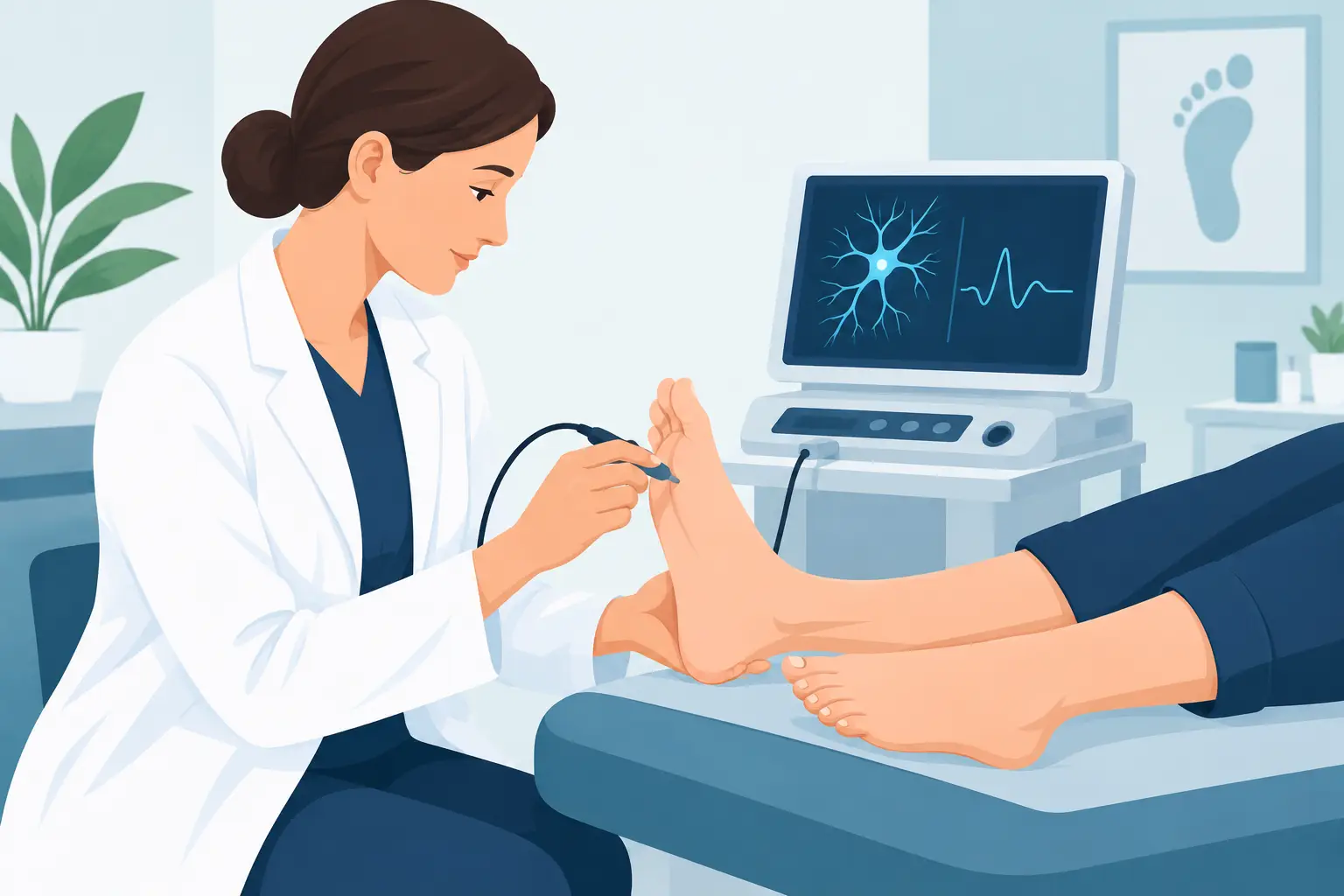
A patient may report numbness only after a callus has become painful, balance has worsened, or a minor wound has failed to heal as expected. By that point, the clinical picture may be more complex than a routine foot complaint. Neuropathy testing for podiatry practices creates an opportunity to identify potential nerve dysfunction and related circulation concerns earlier, before symptoms, skin changes, and preventable complications demand a more reactive response.
For podiatrists caring for patients with diabetes, metabolic syndrome, vascular risk factors, chronic pain, or unexplained sensory complaints, a more complete assessment can strengthen both clinical decision-making and patient conversations. The goal is not to replace the focused foot examination. It is to add objective insight that helps the practice see risks that may not be obvious through symptoms alone.
Why Routine Foot Exams May Not Tell the Full Story
Monofilament testing, vibration perception, pedal pulse assessment, skin inspection, and patient history remain central to podiatric care. They are practical, familiar, and clinically meaningful. Yet neuropathy can progress gradually, and symptoms do not always correlate neatly with functional changes. Some patients minimize tingling or numbness. Others have reduced sensation without realizing it until a shoe injury, fissure, ulcer, or fall reveals the consequence.
A standard exam also has limitations when multiple conditions overlap. A patient with diabetes may have peripheral nerve symptoms, autonomic dysfunction, arterial disease, and impaired healing risk at the same time. Looking at one concern in isolation can leave uncertainty about the broader physiologic factors affecting the lower extremities.
That is why a structured diagnostic approach can be valuable. Objective testing can support documentation, establish a baseline, guide follow-up, and help clinicians determine when a finding warrants additional evaluation, referral, or a change in the care plan.
What Comprehensive Neuropathy Testing Can Assess
A practical testing strategy should be relevant to the patients a podiatry practice sees every day. Sensory complaints matter, but they are only part of the story. The most useful assessments can help evaluate neuropathy-related abnormalities alongside vascular and autonomic factors that may influence symptoms, tissue health, and long-term risk.
Sudomotor Function and Small-Fiber Nerve Activity
Sudomotor testing evaluates sweat gland function, which is controlled by small autonomic nerve fibers. Reduced sweat response can be associated with small-fiber neuropathy and autonomic dysfunction. This can be especially relevant for patients with diabetes, chronic kidney disease, metabolic disorders, or persistent burning, tingling, or altered sensation.
Because small-fiber changes may emerge before more obvious sensory loss, sudomotor assessment can provide useful clinical context when a patient’s symptoms and routine exam findings do not fully align. It should be interpreted as one component of the total clinical assessment, not as a stand-alone diagnosis.
Autonomic Nervous System Function
Autonomic dysfunction can affect heart rate regulation, blood pressure response, sweating, and other involuntary functions. In a podiatry setting, identifying potential autonomic abnormalities may add context for patients who report dizziness, fatigue, exercise intolerance, unexplained pain patterns, or diabetic complications.
Heart rate variability and autonomic function assessments can help reveal patterns that merit clinical attention. For podiatry practices working in coordination with primary care, endocrinology, cardiology, and neurology, this information can make referrals more purposeful and care coordination more informed.
Vascular and Circulation Assessment
A patient can have neuropathy, peripheral arterial disease, or both. Distinguishing among these possibilities is essential when evaluating wounds, cold feet, color changes, claudication symptoms, delayed healing, or diminished pulses.
Assessments such as ankle-brachial index, toe-brachial index, pulse-wave analysis, and pulse wave velocity can offer objective information about lower-extremity circulation and arterial stiffness. ABI can be useful in many cases, while TBI may be particularly helpful when arterial calcification makes ABI results less reliable, as can occur in some patients with long-standing diabetes or chronic kidney disease.
These tools do not eliminate the need for clinical judgment. They can, however, help the provider determine whether a circulation concern should be monitored, addressed through medical management, or escalated for vascular evaluation.
Building Neuropathy Testing Into the Podiatry Workflow
The operational concern is understandable: a practice cannot improve care by adding a process that creates bottlenecks for providers or confusion for staff. The right approach should be protocol-driven and easy to delegate within appropriate training and scope-of-practice requirements.
Testing can be incorporated into defined patient pathways, such as new diabetic patient evaluations, annual diabetic foot assessments, patients with numbness or burning, chronic wound evaluations, high-risk foot follow-ups, and patients with known vascular risk factors. The provider determines which patient groups are appropriate based on the practice’s clinical model and local requirements.
A trained staff member can administer a noninvasive assessment before the provider enters the room. The provider then reviews the resulting report in the context of history, physical examination, medications, comorbidities, and prior findings. This preserves physician and advanced practitioner time while allowing the discussion to happen during the same visit.
The difference is meaningful. Instead of telling a patient that their foot feels numb and scheduling another appointment to investigate, the practice may be able to discuss objective findings, reinforce risk-reduction steps, and determine next actions immediately.
A More Efficient Model for Clinical Insight
US MedResources VitalScan is an FDA 510(k)-cleared, noninvasive platform designed to bring multiple assessments into one workflow. In approximately 15 minutes, trained staff can perform autonomic nervous system, sudomotor or neuropathy, vascular, circulation, and ECG-related assessments. The system provides immediate interpretive reports intended to support clinical decision-making.
For a podiatry practice, consolidating these assessments can reduce the fragmentation that occurs when neuropathy concerns, PAD risk, autonomic questions, and cardiovascular context are evaluated separately or deferred altogether. The platform can assess measures that include heart rate variability, autonomic function, ABI, PAD indicators, pulse-wave analysis, pulse wave velocity, and TBI, depending on the configured testing protocol.
The value is not simply speed. It is the ability to view several potential risk domains together. A patient with reduced sudomotor response, abnormal vascular findings, and a high-risk medical history may warrant a different conversation and follow-up plan than a patient whose symptoms appear isolated and whose objective assessment is reassuring.
Patient Engagement Starts With Clear Evidence
Patients often understand risk more clearly when they can see it. A comprehensive report can turn a vague discussion about numbness into a specific conversation about nerve function, blood flow, and why regular monitoring matters.
This can improve adherence to recommendations that are easy to dismiss when the patient is not in pain. Daily foot checks, glucose management, smoking cessation, protective footwear, skin care, medication adherence, and follow-up appointments become more concrete when connected to objective findings. For patients with diabetes who feel generally well, this context may be particularly useful.
At the same time, practices should avoid overstating what a test result means. Abnormal results require clinical interpretation and, when appropriate, confirmation through additional evaluation. Clear communication protects patient trust: the purpose of testing is to identify potential abnormalities sooner and use that information to make better-informed decisions.
Clinical and Business Value Must Work Together
Podiatry practices face real pressure to deliver thorough care while protecting appointment capacity and maintaining financial health. Adding diagnostic services should be evaluated through both lenses. A service that provides clinically relevant data but requires excessive provider time may not be sustainable. A service that creates revenue without a clear patient-care purpose will not build long-term credibility.
When implemented appropriately, comprehensive neuropathy and vascular testing may support reimbursable diagnostic services and create an additional revenue opportunity. Actual coverage, coding, documentation, medical necessity, payer policies, and scope requirements vary by location and plan. Practices should validate these details with qualified billing and compliance resources before implementation.
The stronger business case comes from alignment. A streamlined testing workflow can support more complete assessments, improve documentation, identify patients who need timely follow-up, and strengthen relationships with referring physicians. It may also help a practice differentiate its diabetic foot care and high-risk patient management services without forcing a major change to its existing schedule.
Choosing the Right Testing Pathway
Not every patient needs every assessment at every visit. The best protocol is based on population needs, clinical objectives, risk factors, and the practice’s ability to act on the results. A diabetic foot clinic may prioritize annual baseline testing and changes in symptoms. A wound-focused practice may place greater emphasis on circulation data. A multispecialty group may use findings to support coordinated referrals across podiatry, primary care, endocrinology, and cardiology.
Before adopting a system, practice leaders should ask practical questions. Can trained staff perform the assessment consistently? Are reports clear enough to support a focused provider discussion? Does the workflow fit within the patient visit? Can the organization document medical necessity and follow compliant billing processes? Most importantly, will the information meaningfully affect patient management?
A demonstration and a customized ROI discussion can help answer these questions using the practice’s own patient mix, staffing model, and growth goals. The right diagnostic program should give the team more than another report. It should give them a clearer reason to act earlier for patients whose feet may be signaling a broader health risk.