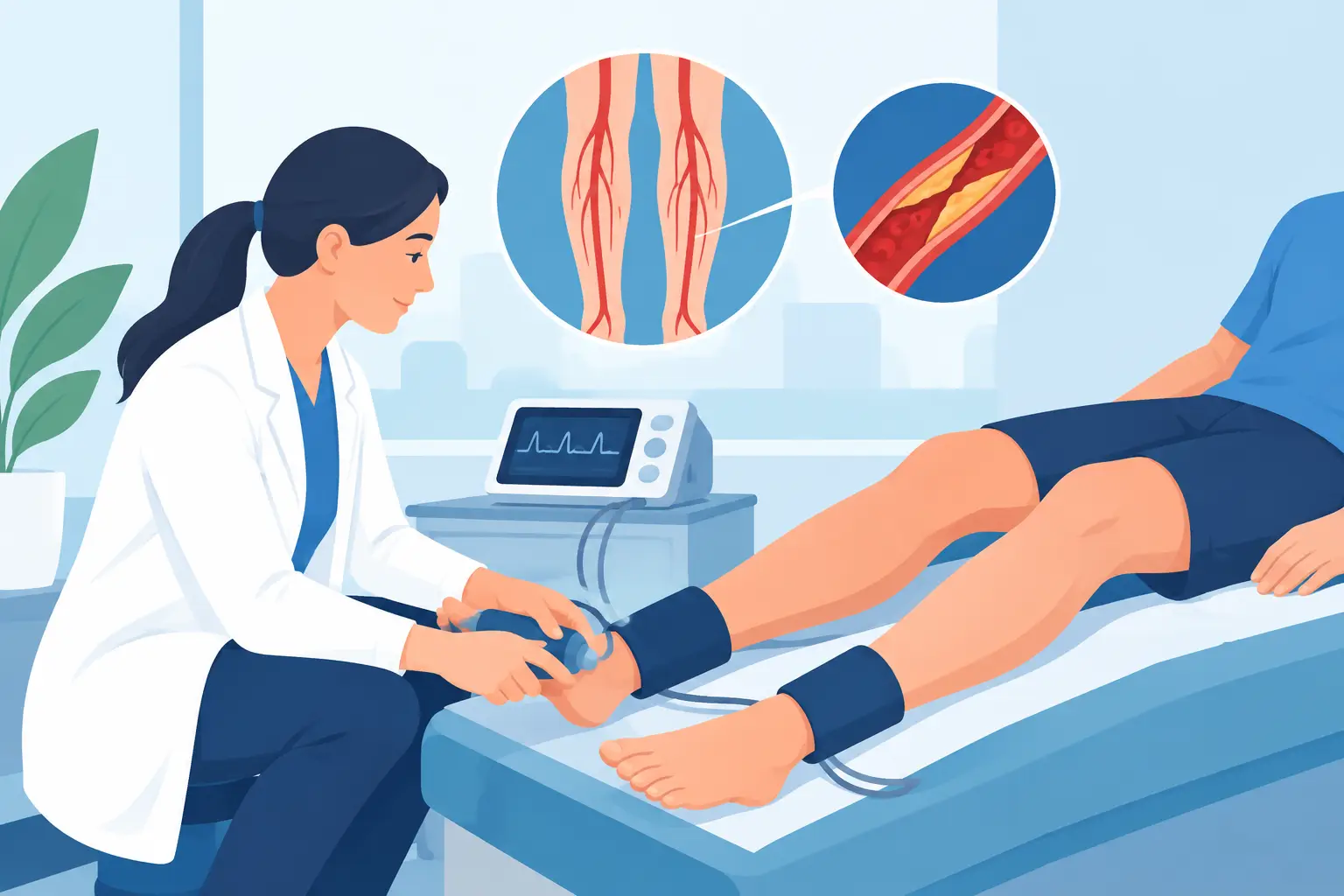
A patient can have clinically meaningful lower-extremity arterial disease long before they describe classic calf pain. Some patients have atypical leg symptoms, while others have reduced activity because of neuropathy, arthritis, frailty, or cardiopulmonary disease. For practices managing diabetes, hypertension, chronic kidney disease, smoking history, or established atherosclerotic disease, peripheral artery disease screening guidelines offer a practical framework for finding risk that may otherwise remain hidden.
The clinical goal is not to test every patient indiscriminately. It is to recognize who is at increased risk, perform an appropriate vascular assessment, and use the results to guide risk reduction, diagnosis, referral, and follow-up. Done well, this approach can help close care gaps while giving patients a clearer understanding of what their circulation health may mean for their mobility, wound risk, and cardiovascular future.
Why PAD is easy to miss
Peripheral artery disease, or PAD, occurs when atherosclerotic narrowing limits blood flow to the extremities, most commonly the legs. It is not solely a circulation problem in the legs. PAD is a marker of systemic atherosclerotic disease and is associated with elevated risk of myocardial infarction, stroke, limb events, and functional decline.
Classic intermittent claudication - reproducible exertional discomfort that improves with rest - remains clinically useful, but it is not the only presentation. Patients may report fatigue, heaviness, cramping, weakness, numbness, burning, or slow-healing foot wounds. Others may have no reported symptoms because their activity level never reaches the threshold that provokes discomfort.
This creates a common clinical gap. A routine office visit may identify diabetes or hypertension, but a focused vascular history, pulse examination, foot inspection, and physiologic testing may not occur until a patient has a wound, rest pain, or a referral for advanced disease. Earlier assessment can give the care team a chance to intervene before that point.
Peripheral artery disease screening guidelines: who should be assessed?
Current major cardiovascular guidance supports a targeted, risk-based approach. A resting ankle-brachial index, or ABI, is reasonable for patients at increased risk for PAD, even when they do not report classic symptoms. Increased-risk groups generally include adults age 65 and older; adults ages 50 to 64 with atherosclerotic risk factors such as diabetes, smoking history, dyslipidemia, hypertension, chronic kidney disease, or a family history of PAD; and younger adults with diabetes plus another atherosclerotic risk factor.
A focused assessment is also appropriate when a patient has exertional leg symptoms, nonhealing wounds, diminished pulses, ischemic skin changes, prior abnormal vascular findings, or known coronary, carotid, renal, or lower-extremity arterial disease. These patients are no longer simply screening candidates. Their presentation may warrant diagnostic evaluation.
The U.S. Preventive Services Task Force has found insufficient evidence to recommend routine ABI screening for all asymptomatic adults without known PAD or cardiovascular disease. That distinction matters operationally. Practices should avoid a one-size-fits-all testing strategy and instead build protocols around documented risk, symptoms, examination findings, and clinical judgment.
Build risk identification into routine chronic care
The most efficient screening programs do not depend on a patient volunteering the right symptom. They incorporate targeted vascular questions and foot-focused observations into diabetes visits, annual wellness workflows, cardiovascular risk reviews, and chronic disease follow-up.
Ask whether leg discomfort occurs with walking, whether it resolves after rest, and whether walking distance has changed. Ask about nighttime foot pain, wounds that are slow to heal, color or temperature changes, and prior vascular procedures. For patients with diabetes or neuropathy, recognize that sensory loss can obscure ischemic discomfort. A patient who says, “My feet do not hurt,” may still need a careful circulation assessment.
Selecting the right test for the clinical question
The resting ABI is the standard initial physiologic test for suspected PAD. It compares systolic blood pressure measured at the ankle with pressure measured at the arm. When performed and interpreted appropriately, it provides an objective assessment of lower-extremity arterial perfusion.
ABI values are commonly categorized as abnormal at 0.90 or below, borderline from 0.91 to 0.99, normal from 1.00 to 1.40, and noncompressible above 1.40. An abnormal ABI supports PAD in the appropriate clinical setting. A borderline result does not rule out disease, particularly when the history is concerning.
An ABI above 1.40 can be misleading rather than reassuring. Medial arterial calcification may make vessels difficult to compress, a concern seen more frequently in patients with diabetes and chronic kidney disease. In this setting, a toe-brachial index, or TBI, can provide more useful information because toe arteries are less likely to be noncompressible.
When symptoms suggest PAD but the resting ABI is normal or borderline, exercise ABI testing may uncover exertional flow limitation. Segmental pressures, pulse volume recordings, Doppler waveforms, duplex ultrasound, and other imaging may be selected based on the clinical question, local capability, and whether revascularization is under consideration.
The important operational point is that a test should lead somewhere. A practice needs a defined pathway for abnormal, borderline, noncompressible, and symptom-test mismatch results. Ordering a vascular study without a follow-up plan can create more fragmentation, not more insight.
Physical examination still matters
Technology strengthens the assessment, but it does not replace a careful examination. Guidelines support obtaining a vascular review of systems and examining lower-extremity pulses, skin integrity, temperature, color, hair distribution, and the presence of ulcers or gangrene in patients at risk.
Pulse findings alone do not diagnose or exclude PAD. They do, however, help identify patients who need further evaluation and establish useful clinical context for physiologic measurements. In patients with diabetes, a structured foot examination should include both neuropathy and vascular considerations. Loss of protective sensation and reduced perfusion together can substantially increase the risk of unnoticed injury and poor healing.
Turning results into patient-centered action
An abnormal screening or diagnostic result should trigger more than a problem-list entry. Management often includes smoking cessation support, lipid lowering, blood pressure and diabetes management, antiplatelet therapy when clinically indicated, exercise therapy, foot-care education, and consideration of specialist referral. The exact plan depends on symptoms, limb threat, comorbidities, medication tolerance, and the overall cardiovascular risk profile.
Patients with rest pain, tissue loss, gangrene, rapidly worsening wounds, or signs of acute limb ischemia require urgent evaluation. These are not routine screening scenarios. Clear triage standards help staff recognize when immediate escalation is necessary.
For less urgent findings, patient communication can improve adherence. Explaining that PAD may affect both leg health and heart-and-brain risk gives patients a reason to engage with treatment plans. A report that clearly shows vascular findings can make a conversation about smoking, walking activity, statin therapy, diabetes control, or foot surveillance more concrete.
Making guideline-based assessment workable in practice
The barrier is often not awareness. It is workflow. Many organizations serve large populations with overlapping risks for PAD, neuropathy, autonomic dysfunction, and cardiovascular disease, yet rely on separate appointments or referrals to evaluate each concern. That can delay assessment and increase the chance that high-risk patients do not complete testing.
A practical program begins by defining eligible populations in the electronic health record, assigning trained staff roles, standardizing the intake questions, and establishing clinician review and referral protocols. Results should be available quickly enough to support a same-visit discussion whenever possible. Organizations should also confirm documentation requirements, payer policies, and coding practices before implementing new diagnostic services.
For practices seeking a more consolidated workflow, VitalScan is an FDA 510(k)-cleared, noninvasive platform that combines vascular assessment, including ABI, PAD, pulse-wave analysis, and TBI capabilities, with autonomic, sudomotor/neuropathy, and ECG-related assessments in an approximately 15-minute staff-administered workflow. A comprehensive report can support clinical review, but it should be used within a provider-led process that considers the patient’s history, examination, and any need for confirmatory testing or referral.
The financial case should follow the clinical case. When assessment is appropriately targeted and documented, practices may be able to add valuable diagnostic services, improve care-gap outreach, and strengthen patient retention without creating a disruptive stand-alone testing department. The opportunity varies by payer mix, setting, staffing model, and local coverage rules, so a customized operational and reimbursement review is more useful than broad revenue assumptions.
A focused next step for care teams
Review the patients scheduled for the next several weeks who have diabetes, smoking history, chronic kidney disease, hypertension, dyslipidemia, exertional leg complaints, numbness, or foot concerns. Then ask a simple question: does the practice have a consistent way to identify vascular risk and act on the result? A brief demonstration and customized workflow review can help determine whether a more comprehensive assessment model fits your clinical priorities, patient population, and operational goals.