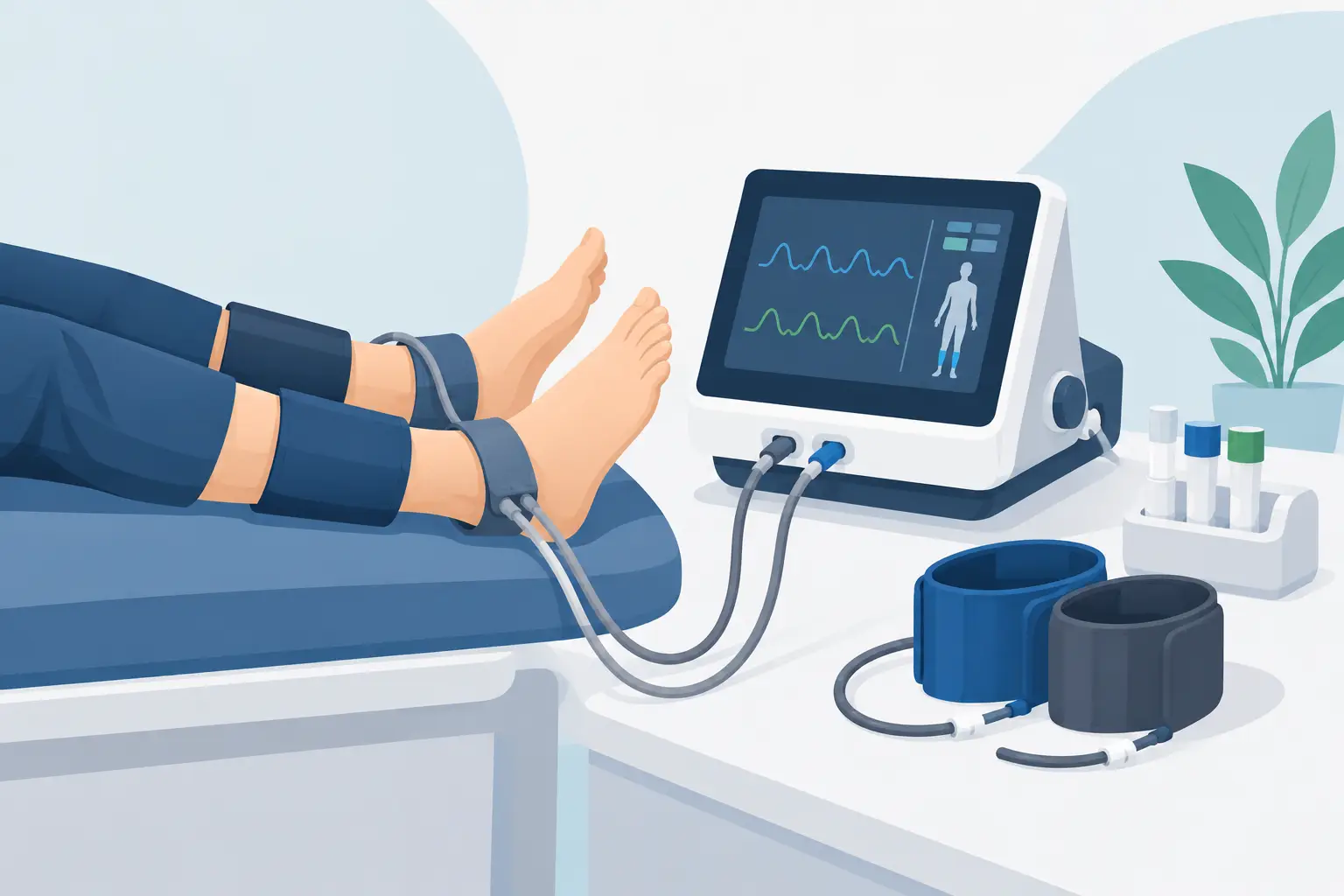
A patient with diabetes reports calf fatigue when walking, but has no visible wound and palpable pulses are difficult to interpret. Another patient has numb feet, hypertension, and a long history of smoking. In both cases, ankle brachial index testing equipment can help turn a circulation concern into an objective assessment that supports earlier clinical decision-making.
For practices managing chronic disease, the question is not simply whether to offer ABI testing. It is whether the equipment fits the patient population, produces clinically useful information, and can be incorporated into care without creating another operational bottleneck. The right approach can help identify potential peripheral artery disease (PAD) earlier, support risk stratification, and create a more complete picture of vascular health.
Why ABI testing belongs in proactive care
The ankle-brachial index compares systolic blood pressure measured at the ankle with systolic pressure measured at the arm. A lower ratio may indicate reduced blood flow to the lower extremities and can raise concern for PAD. This matters because PAD is frequently underrecognized, particularly in patients whose mobility limitations, neuropathy, or atypical symptoms mask classic claudication.
ABI assessment is especially relevant for patients with diabetes, tobacco exposure, hypertension, hyperlipidemia, chronic kidney disease, obesity, established cardiovascular disease, lower-extremity symptoms, nonhealing wounds, or diminished pulses. For these populations, vascular risk rarely exists in isolation. It may coexist with neuropathy, autonomic dysfunction, coronary risk, and foot complications.
A delayed vascular finding can mean missed opportunities for risk-factor intervention, medication review, vascular referral, foot-protection education, and closer follow-up. By incorporating objective testing into a preventive or chronic-care workflow, providers can evaluate concerns before they become an urgent limb or cardiovascular event.
What ankle brachial index testing equipment should measure
Traditional ABI measurement typically involves a blood pressure cuff and Doppler ultrasound to obtain systolic pressures in both arms and at the dorsalis pedis and posterior tibial arteries. This method remains clinically meaningful, but it depends on proper cuff placement, patient positioning, technique, and consistent documentation.
Modern ankle brachial index testing equipment may streamline data capture through automated cuffs, sensors, software-guided workflows, and digital reporting. The value of automation is not simply speed. It can help reduce variation in repetitive steps, organize measurements in a standardized format, and make the results easier to review over time.
However, not every patient is well served by ABI alone. Arterial calcification can make lower-extremity vessels poorly compressible, particularly among patients with diabetes, advanced kidney disease, or older age. In those cases, an ABI can be falsely elevated or otherwise difficult to interpret. Equipment that also supports toe-brachial index (TBI) testing can add useful clinical context because toe arteries are often less affected by medial arterial calcification.
Pulse volume recordings and pulse-wave analysis may provide additional information about lower-extremity perfusion and arterial characteristics. These tools do not replace clinical judgment, vascular imaging, or referral when indicated. They can, however, help a provider recognize when the clinical picture warrants closer attention.
The report is part of the equipment decision
Raw pressures and ratios are only useful if they are available when the clinician needs them. A clear report should organize the relevant values, flag potentially abnormal findings according to the system's intended use, and support documentation in the patient record.
For a busy practice, interpretive clarity matters. A staff member may administer the test, while the provider needs a concise, reviewable result that can be discussed with the patient during the same visit or incorporated into a follow-up plan. When results are difficult to retrieve or explain, even technically capable equipment can become underused.
Selecting a system for real clinical workflows
The best system depends on the care setting. A podiatry practice may prioritize lower-extremity vascular assessment for patients with diabetes, neuropathy, and wound risk. A primary care or internal medicine practice may need a broader preventive platform that supports cardiovascular risk discussions and chronic disease management. Cardiology, neurology, pain management, endocrinology, rural health clinics, and community health centers may each have different testing volumes and staffing models.
When evaluating equipment, organizations should consider several practical questions:
- Can trained clinical staff administer the test consistently without requiring a highly specialized operator?
- How long does a complete assessment take, including patient preparation and report generation?
- Does the system accommodate patients with mobility limits, edema, fragile skin, tremor, or difficulty lying still?
- Are ABI, TBI, pulse-wave, and related vascular assessments available when they are clinically appropriate?
- Does reporting support provider review, patient education, documentation, and longitudinal comparison?
- What training, implementation support, service expectations, and data-management processes are included?
The lowest acquisition cost is not always the lowest operational cost. A basic Doppler-and-cuff setup may be appropriate for a practice with experienced staff, low testing volume, and a focused need for ABI measurement. A more integrated platform may be a stronger fit for organizations seeking standardized protocols, broader diagnostic capability, faster report turnaround, and a repeatable preventive-care service line.
Accuracy starts before the test begins
Even sophisticated equipment cannot compensate for poor preparation. ABI results are influenced by patient position, cuff selection and placement, rest time, movement, arrhythmias, and the quality of pressure acquisition. Organizations should establish protocols that reflect the device instructions for use and the practice's clinical standards.
Patients generally need time to rest in a supine position before measurement. Staff should use appropriately sized cuffs, avoid placing cuffs over wounds when possible, document factors that may affect testing, and recognize when a reading does not fit the patient's symptoms or examination. An abnormal, borderline, noncompressible, or technically limited result should prompt clinical review rather than an automatic conclusion.
This is where a comprehensive assessment can be valuable. A patient with numbness, dizziness, foot pain, or fatigue may have overlapping vascular, neurologic, metabolic, and autonomic considerations. A single measurement answers a focused question. A coordinated testing strategy can help providers see the broader pattern.
From a vascular test to a patient conversation
ABI testing can make risk more tangible for patients who feel well or view chronic conditions as abstract. A visual report gives the care team a practical starting point: circulation appears potentially reduced, risk factors need attention, or further evaluation may be appropriate.
That conversation can support better engagement around smoking cessation, glycemic management, blood pressure control, statin therapy when clinically indicated, activity recommendations, foot checks, and referral follow-through. It also gives patients a reason to return for monitoring when their risk profile changes.
For organizations, the opportunity is clinical first, but operational value follows. A well-designed diagnostic workflow can support more complete evaluations, help close care gaps, and create potential reimbursable service opportunities. Coverage, coding, medical necessity, documentation, and payer requirements vary, so practices should validate their billing approach with qualified coding and compliance resources before implementation.
A broader diagnostic strategy may offer more value
Practices do not have to build separate workflows for every cardiovascular, neurologic, and vascular concern. VitalScan is an FDA 510(k)-cleared, noninvasive platform designed to combine vascular assessments, including ABI, PAD, pulse-wave analysis, and TBI, with autonomic nervous system, sudomotor/neuropathy, and ECG-related testing in an approximately 15-minute staff-administered workflow. Immediate interpretive reporting can help clinicians evaluate multiple potential risk areas without sending the patient through a fragmented testing process.
For the right organization, this model can support earlier identification while giving providers a more complete basis for discussion and follow-up. The appropriate configuration still depends on patient mix, clinical goals, staffing capacity, and the services the practice is prepared to provide after an abnormal result.
Build testing around the next clinical step
Ankle brachial index testing is most valuable when it is connected to action. Before selecting equipment, define who will be tested, how staff will be trained, who will review results, how findings will be documented, and what referral or follow-up pathway will be used. Consider reviewing a demonstration, discussing the expected workflow with stakeholders, and requesting a customized ROI assessment based on patient volume and service goals.
The strongest equipment decision is the one that helps your team recognize potential risk sooner, explain it clearly to patients, and move confidently to the next appropriate step in care.